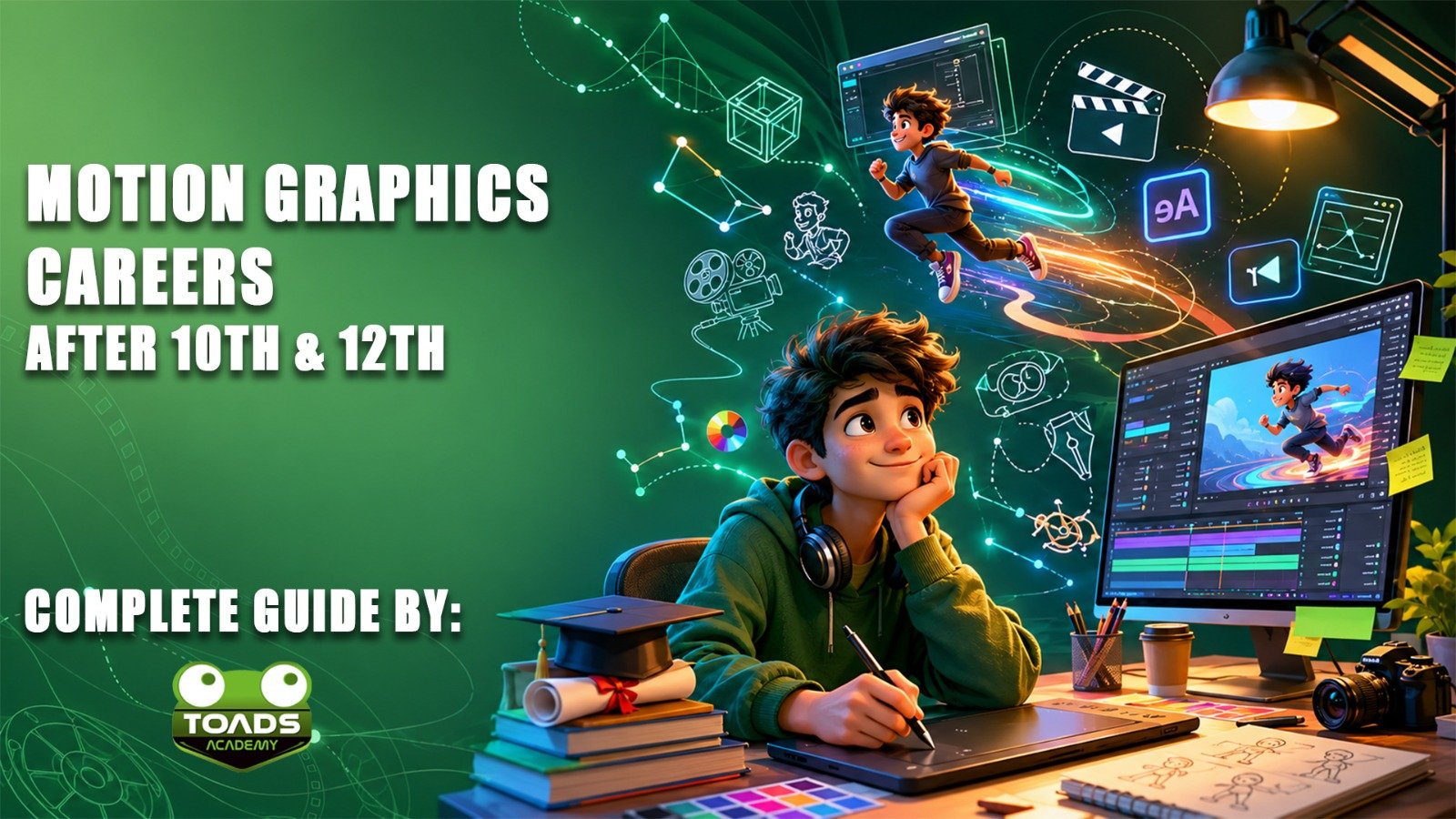

Here’s something worth saying plainly: the creative industry has a gatekeeping problem. Students are told, often by family, sometimes by schools, that real careers require degrees, entrance exams, years of academic qualification. Motion graphics quietly break that logic. You can finish 10th standard, walk into the right training programme, spend 6–12 months actually learning, and come out the other side with a portfolio that gets you hired. No entrance exam. No three-year wait.
That’s not a sales pitch. That’s just how the field works.
What Motion Graphics ?
Motion graphics get confused with animation constantly, so let’s clear it up.
Traditional animation is about characters, their expressions, their journeys, the stories they carry. Motion graphics is about information. It’s what happens when a designer takes text, shapes, data, and brand elements and makes them move with intention. The animated logo at the start of a YouTube video. The lower-thirds on a news broadcast. The kinetic typography in that product explainer you watched twice because it actually made sense. All motion graphics.
The skill is not just making things move. It’s making movement mean something using timing, rhythm, and visual hierarchy to guide what a viewer feels and understands within the first three seconds of watching.
Three seconds, by the way, is roughly how long you have on Instagram before someone scrolls past. Motion designers live inside that constraint.
Why 2026 Is a Particularly Good Time to Enter This Field
Short-form video didn’t just grow, it ate the internet. Instagram Reels, YouTube Shorts, OTT pre-rolls, branded content on connected TVs every one of these formats runs on motion graphics. Brands that used to hire one video team now need content across eight platforms simultaneously, and they need it to look different on each one.
The result is a genuine shortage of mid-level motion designers in India. Agencies have the senior talent and can hire freshers, but the gap between “just learned After Effects” and “can run a campaign independently” is where demand is loudest. That’s the gap a structured training programme should close.
Salaries reflect this. Freshers with solid portfolios are entering at ₹15,000–₹30,000 per month. Two to four years in, with strong work and specialisation, ₹40,000–₹80,000 is realistic. Freelancers who build a client base particularly those who combine motion skills with content strategy regularly earn above those numbers.
The Skills That Actually Matter
Everyone talks about After Effects. After Effects is a tool. What you do with it depends on foundations that no software can give you.
Typography is the one most beginners underestimate. Motion design is, at its core, type in motion. If you don’t understand font pairing, visual hierarchy, and why certain typefaces feel authoritative versus playful, your animations will look technically competent and creatively empty.
Colour theory is not about making things look pretty. It’s about control telling the viewer’s eye where to go, what to feel, how to interpret what they’re seeing. Colour is the first thing that hits before a single element moves.
Composition and layout come before animation, not after. A badly composed frame doesn’t become good because you added a keyframe to it. The designers who skip this stage spend their careers wondering why their work looks “a bit off.”
Animation principles — the actual craft of movement are what separate designers from animators. Timing. Easing. Weight. Anticipation. These were formalised by Disney animators in the 1930s and they apply just as precisely to a bouncing logo badge as to a cartoon character falling down stairs.
Master these four in combination and the software becomes straightforward. Skip them and no amount of tutorial-watching will fix it.
What the Motion Graphics Apex Course at TOADS Academy Covers
TOADS Academy runs its Motion Graphics Apex programme at its Shivajinagar campus Pune. It’s the educational arm of Flying Toads, a VFX studio with over two decades of production experience. That context matters: the curriculum is built by people who work in the industry, not people who teach about it from a distance.
The programme begins with digital design fundamentals and digital filmmaking basics not to slow things down, but because motion designers who don’t understand how a frame is constructed make different (worse) decisions than those who do. From there it moves into broadcast workflows, motion production, and hands-on software training across After Effects, Premiere Pro, Photoshop, Illustrator, and Audition.
The output is a portfolio and a showreel which is what actually gets you hired, not a certificate.
Where You Can Go With This
The obvious destination is motion graphics designer at an agency or studio creating animated content for brands, campaigns, and digital platforms. But the field branches:
Video editors who understand motion graphics are significantly more hirable than those who don’t. Editing is no longer just cutting clips.
UI motion designers are in high demand as apps and digital products increasingly rely on micro-animations and transitions to communicate state changes and guide users.
Broadcast designers work with television channels and media houses packaging, promos, title sequences. More structured, often higher-paying.
Freelancers who specialise in, say, in explainer videos for SaaS companies, or animated reels for D2C brands can build remarkably sustainable independent businesses. Some of the best-paid motion designers in India work for three clients, not thirty.
Start After 10th or 12th. Start Now if You Can.
The window between finishing school and feeling obligated to choose a “serious” path is short. Motion graphics is one of the few creative fields where you can spend that window productively learning something real, building something tangible, and entering an industry that will keep growing regardless of what else changes in the economy.
Book a free counselling session at TOADS Academy Pune. Ask them to show you student work from the last batch. Look at the portfolio. Then decide.
That’s the only pitch you need.